

Why We Write: Allison Lee
Read reflections from 2025 annual Black List alum Allison Lee in this special edition of Why We Write...

Today, we’re bringing you a unique Why We Write essay from 2025 annual Black List writer Allison Lee. Allison’s script OH YOKO! explores the story of prolific artist Yoko Ono. Allison was recently able to preview the MUSIC OF THE MIND exhibit about Ono’s life and work at The Broad and details her experience here.
Take it away, Allison!
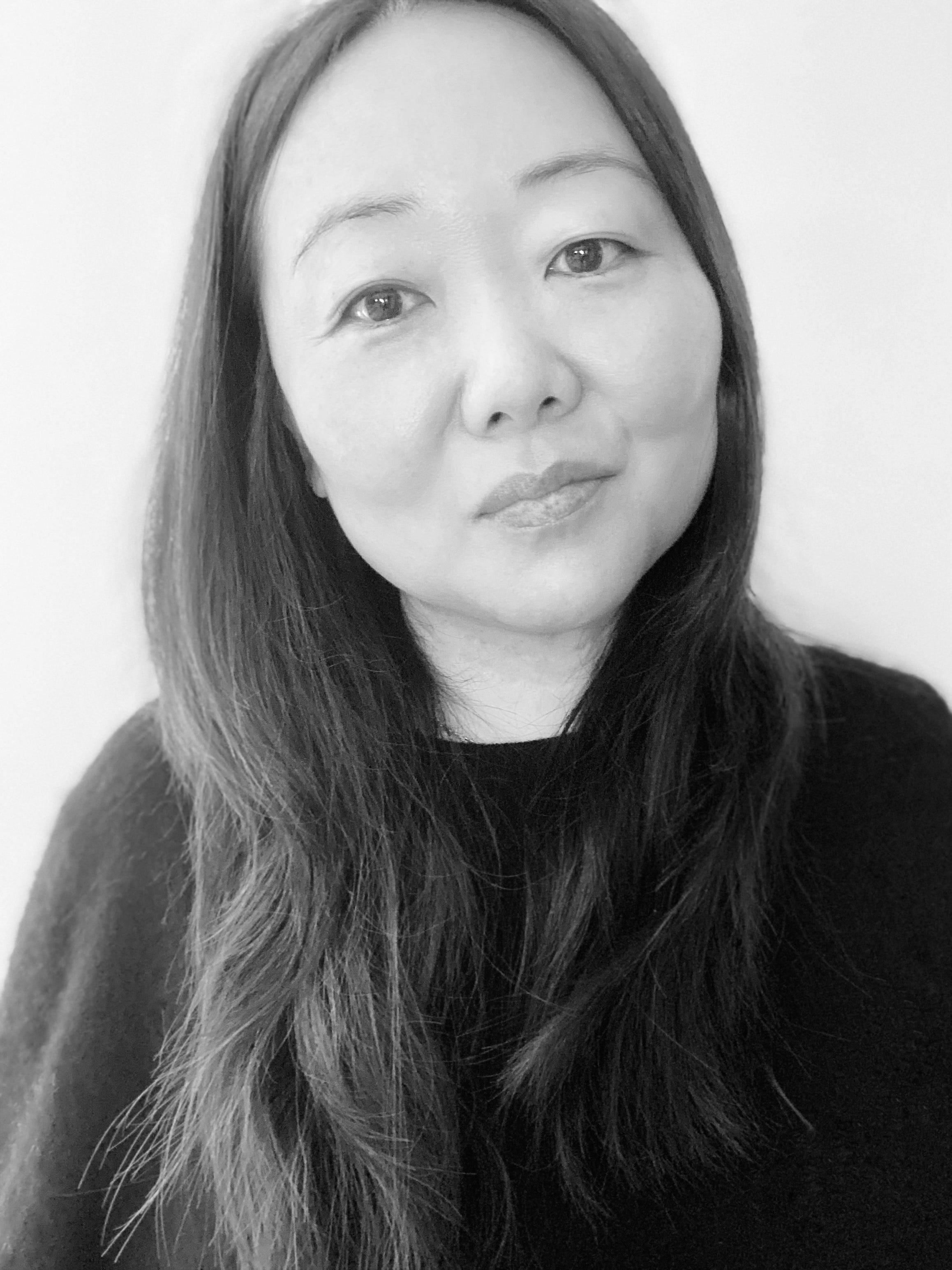
Recently, I was outed on a podcast. Chris Hill of the Blacklisted podcast kindly chatted with me about my script OH YOKO! which made it on to The Black List in 2025. During the course of the interview, he asked about the inception of the project, wondering if my representatives ever dissuaded me from tackling a subject whose life rights are tied to The Beatles. Sam Mendes, anyone? Unbeknownst to me, Chris had already interviewed my manager Jon Hersh, and Jon had disclosed that I began working on an outline without informing anyone.
Of course we must try and write screenplays by which our careers progress, but the story of Yoko Ono was one that I just couldn’t let go. After having borne witness to her incredible body of work, I had to rectify my malformed and mass-produced POV of her. I was driven to write about Yoko Ono after I first caught her MUSIC OF THE MIND exhibition at the Tate Modern. This May, I was lucky enough to be invited, along with director Rachel Goldberg, to preview the retrospective again at The Broad.
Like most, I was introduced to Yoko Ono through The Beatles. My immigrant mother preferred classical music, while my father loved trot, but The Beatles were our common ground. One of the first songs that I learned to play on the piano was “Love Me Do,” and still, many a K-drama features “Yesterday.” But back then, I, too, believed Yoko to be the villainess who broke up the greatest band that ever was. Growing up in Los Angeles, some of things I was called as a child were industry-related references. Sometimes it was Wednesday of THE ADDAMS FAMILY (the foreign monsters on the block, very clever) or Bruce Lee’s daughter (I was semi-proud of this one) but the epithet I despised the most was “Yoko Ono.”
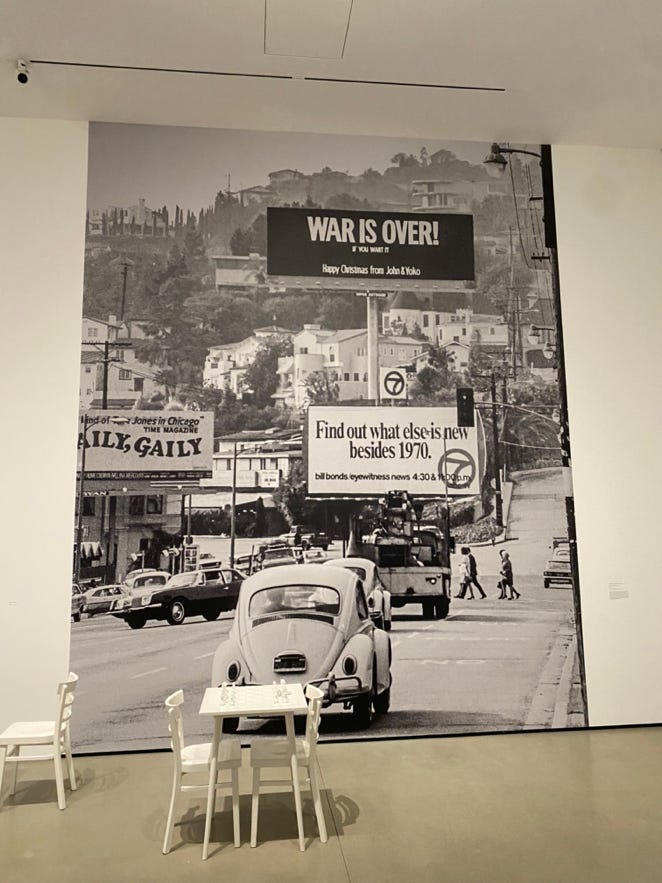
So, as an adult, I went into MUSIC OF THE MIND with a skeptical heart. I knew Yoko merely as the Japanese woman who had gotten lucky with John Lennon, the true artist in the relationship. I had also just watched Peter Jackson’s indelible GET BACK with its hours of footage as proof of The Beatles’ genius.
My very first encounter with Ono’s art would prove me wrong. At the Tate, I was mesmerized by live footage of the sky on a flatscreen. I was charmed by “Sky TV,” especially in light of the diametrically opposed Murdoch media entity, and admired how forward-thinking Ono was to have created a live stream in the 60s. Here at The Broad in Los Angeles, an old television sits ground-level while broadcasting images of the bright blue California sky above.
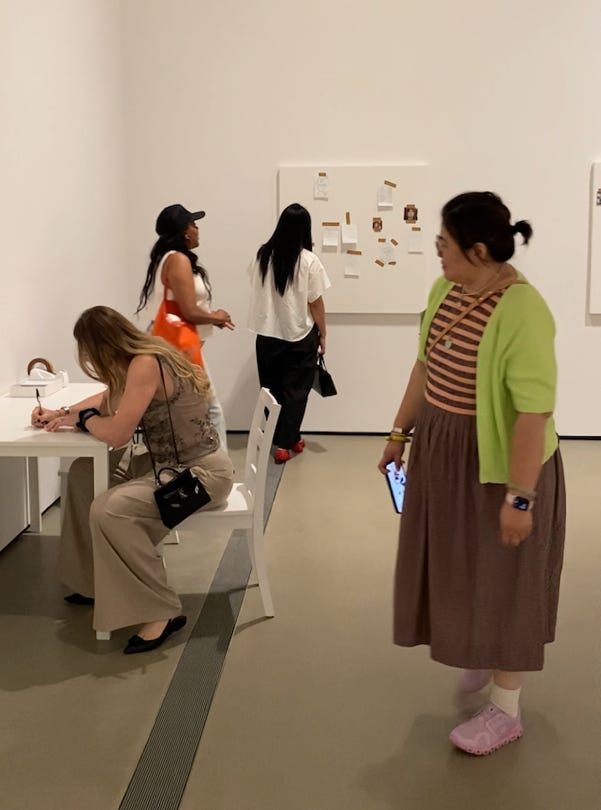
In “My Mommy was Beautiful,” Ono invited the audience to participate as she often did with her instructional art. Ono composed, like sheet music, the basic framework by which the art was to be performed. In “Mommy,” one was to post notes or artwork referencing their own mothers. Nude images of a woman’s body, an omnipotent Mother, loomed over the room as we confessed and processed our complicated feelings about the women who birthed, raised, abandoned, hurt, and loved us.
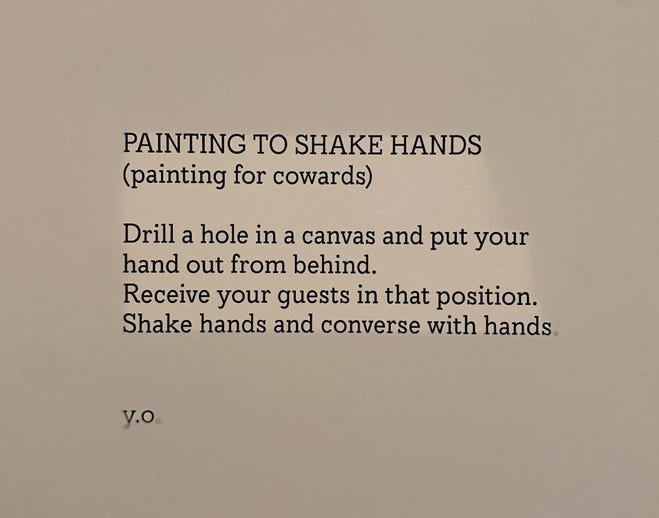
In writing, they say context is everything. There’s a degree of persuasion involved in what we write — here’s what the character experienced, do you see yourself in their journey, too? I felt such an emotionality stemming from Ono’s avant-garde and theoretical pieces, I knew there would be more to how and why she created them. I was compelled to uncover the context for her work.
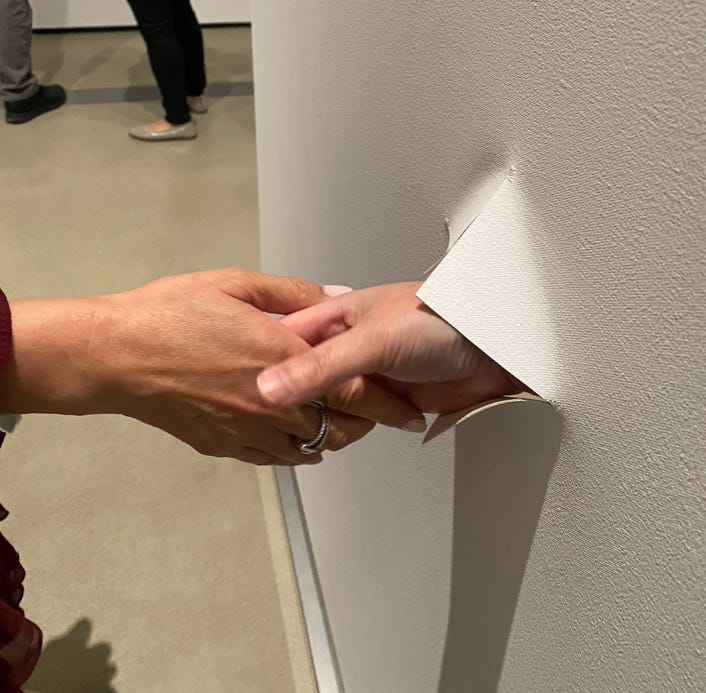
Indeed, “Sky TV” is an homage to Ono’s childhood, to her having to grow up in war-torn Tokyo. Often, Ono would turn to her imagination to process destruction and devastation. When hungry, she would instruct her little brother to imagine ordering from a menu or tell him to take comfort in the omnipotent sky. In my middle school history class, I learned that even one tiny scratch from the nuclear fallout could lead to death. How was it possible to have lived in abject fear, and yet have grown into a resilient woman who created imaginative and playful art?
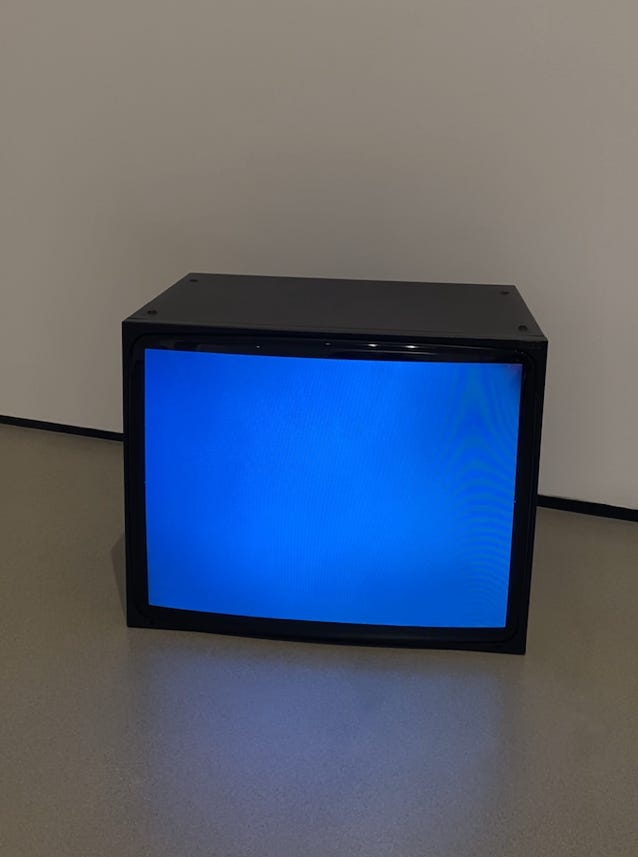
Likewise, when participating in “My Mommy Is Beautiful,” there was such transcendental feeling in the communal exploration of our maternal relationships. Ono dedicated this piece to Lennon’s mother, Julia, who had died in a car crash, and many know his song for her. But there was more to be unearthed from the interactive and cathartic piece. Upon researching her history, I discovered that Ono’s own mother was an exacting artist who felt conflicted about her daughter’s journey. A tiger mom, one might say.
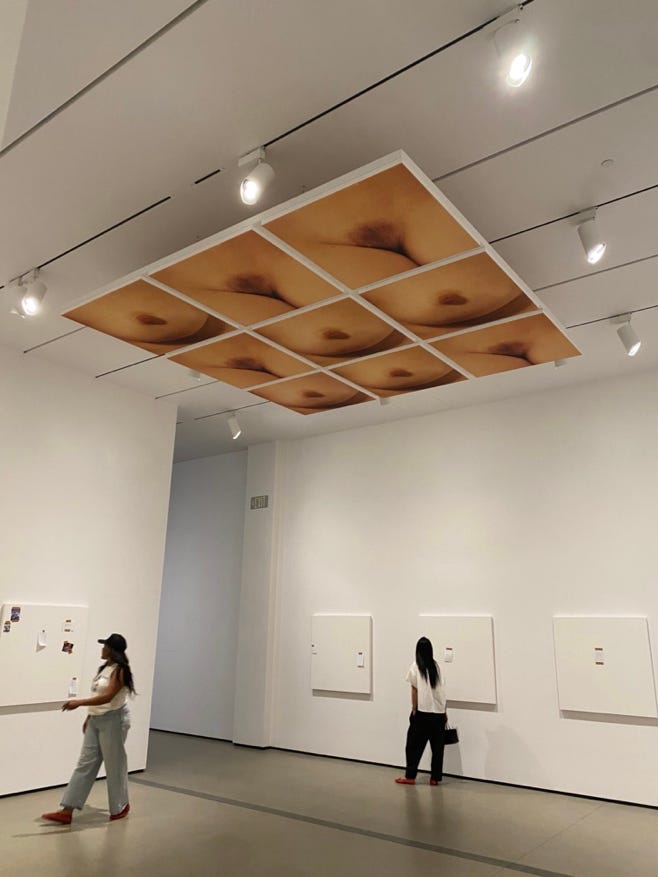
These are only some examples of the conceptual mastery and forward-thinking practices in Yoko Ono’s work. And as an Asian-American female creative, I was remorseful that I had long discounted Ono because of my having readily accepted prevailing narratives. Upon experiencing MUSIC OF THE MIND once more, I was struck by the scope and achievements of her stand-alone career. Ono’s prescient wielding of group think, prompts, programming, and exchange activates a core message of profundity. She reminds us of our humanity and its optimism, that in the end, we do seek one common goal, that of peace.
When you walk into MUSIC OF THE MIND at The Broad, one of the first works you see is “Lighting Piece,” which Ono first performed in Tokyo in 1955. In footage from 1966, Ono lights a match, and the flame disappears in gossamer wisps of smoke, temporal imagery hinting at meanings to come. So this is the context for my script: to confess my own self-hating assumptions that kept me from experiencing her art, to reclaim this “difficult” woman through a more enlightened lens, and finally, to celebrate Yoko Ono’s work. After all, isn’t this why we screenwriters write, to expose what we have learned, to light up a darkened room so that we may see each other, even if only for a moment.
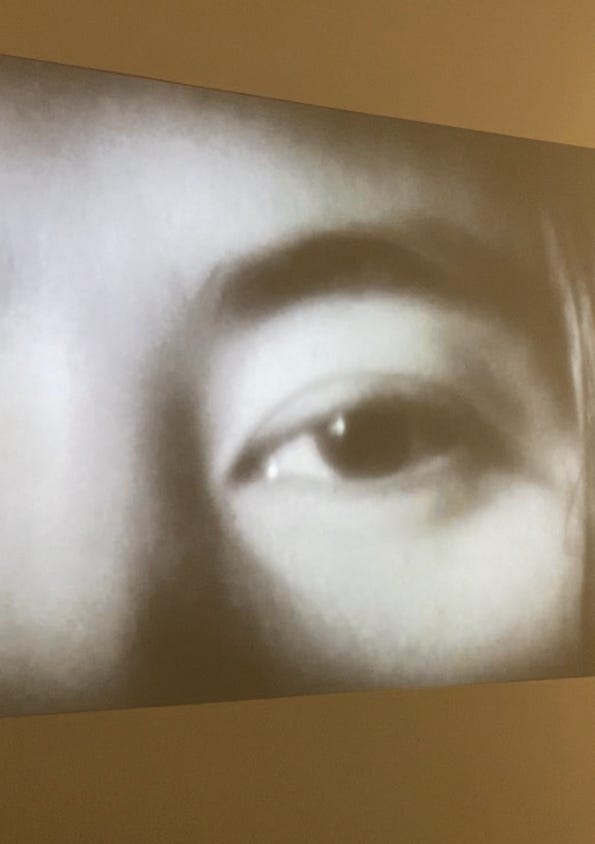
Yoko Ono’s MUSIC OF THE MIND is at The Broad from now until October 11, 2026.
Allison Lee adapted the novel THROWBACK by Maurene Goo for Sister Global and Hello Sunshine with Nisha Ganatra (FREAKY FRIDAY 2) directing. She was also hired to pen an animated feature for Netflix Animation and previously co-wrote the pilot BAD KOREAN, based upon the book My Korean Deli, with Sheila Callaghan (DYING FOR SEX) producing and Jamie Chung starring for AMC Studios. Allison has completed feature assignments for Paramount with Alloy Entertainment and for Universal with Misher Films. In television, she has developed a half-hour pilot with Westbrook Inc. for Candle Media and a limited series for Amazon TV with Lisa Joy and Kilter Films producing. Her original screenplay JAWBONE received the support of Film Independent and the Sundance Institute, and it was her feature OH YOKO! that landed her on the 2025 Black List.
More Why We Write:
Jainaba M. Seckan on writing through loss and finding new purpose
Brandon Carbaugh on writing for his beloved brother
Simon Nagel on letting your inner child lead the way
If you’re not already a member of the Black List website, here you go:
Writers: Create a free Writer Profile and whenever you’re ready (and only then) upload your project, order professional feedback, and explore the various opportunities we have from time to time.
Industry Professionals Register for an Industry Membership to discover new material before everyone else.
See you in the comments.
Right on! Can't wait to watch the movie.
Hot take: Yoko's "Yes, I'm a Witch" is a better song than a nontrivial portion of the Beatles entire discography.