

Why We Write: Kryzz Gautier
Our beloved series is BACK!

Today, we’re sharing a new Why We Write essay from Kryzz Gautier. Kryzz is an alum of the 2020 Black List x WIF Episodic Lab, the 2021 annual Black List and the 2025 annual Black List for her feature DON’T DO 72. Her 2021 annual Black List script WHEELS COME OFF was also featured on the GLAAD List and the Disability List back in 2024.
Keep scrolling to read more about how genre allows Kryzz to fully express her own unique creative voice…
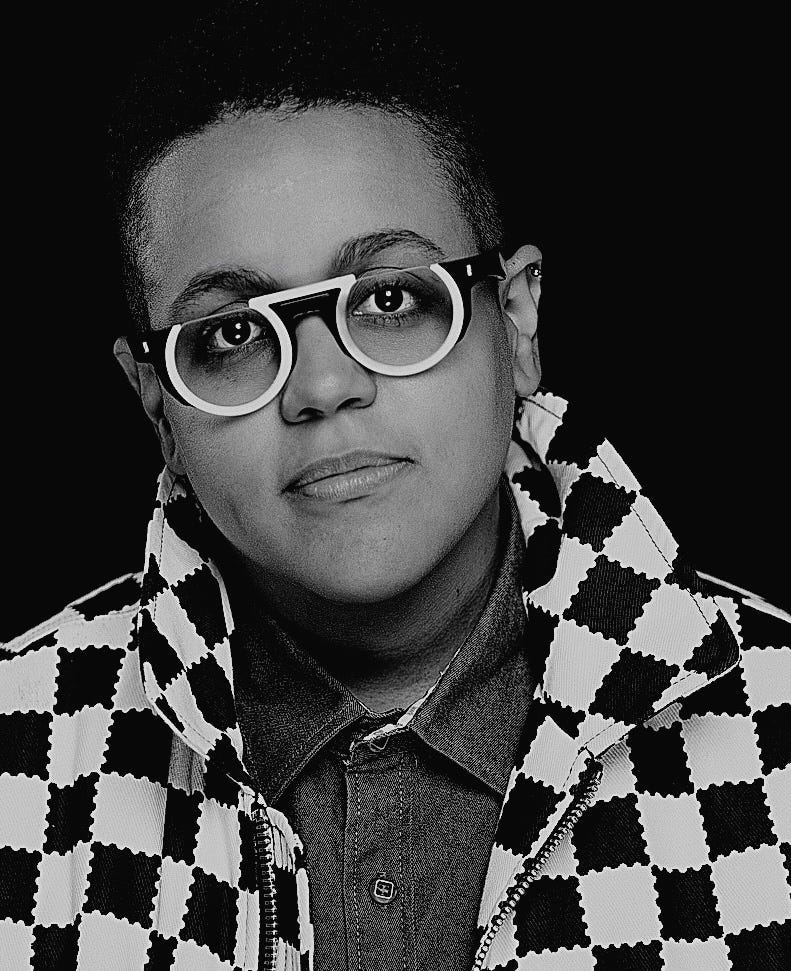
I write genre because realism was never designed to let me through the door. The last time I even attempted to pitch a contemporary drama centering a queer Afrolatina lead, the producer posited she be white instead. “To broaden the potential demo,” they said. Verité has a bouncer and he’s checking for papers I’ll never have.
Realism, as practiced by the American entertainment industry, operates with a permission structure. It requires proof of market viability, proof of cultural legibility, proof that your story won’t make anyone uncomfortable in ways that threaten profit. That structure teaches us early what kinds of lives are treated as series engines and which are exclusively considered guest stars of the week.
For marginalized writers like me (woman, queer, Latina, immigrant, otherwise intersectionally othered) that often translates to a binary choice. Be absent or be a stereotype. We’re forced to show up as the sidekick. The predicament. The teaching moment. The digestible token that reassures the system it’s working as intended.
The industry doesn’t solely disregard people by excluding them. It further neglects them by restricting how they can appear. If you’re only permitted to experience trauma, misery becomes your job. If you’re only portrayed as resilient, pluckiness becomes your brand. There’s a quiet lie embedded in conversations about representation. They claim presence alone is progress when inclusion without authorship is just another brand of erasure. Visibility doesn’t always equate substance or authenticity.
I was not supposed to be the narrator in “traditional” storytelling. So I favor genre because it seeks no approval.
I don’t choose science fiction, horror, or fantasy because my life feels unreal. I choose them because dramas and comedies have no room for me unless I arrive as an example or an exception. Genre doesn’t ask me to prove my story deserves oxygen. It doesn’t compel my body to stand in for an entire community. It doesn’t decree my pain be instructional.
Genre has always been my lane because it lets me write at scale. It’s how I insist on creative control in a system that prefers my absence. It put me at the center without apology for my specificity. I’m the consciousness shaping the world instead of the form reacting to it. It’s the difference between spending my energy justifying why I’m centered on the page and spending it building the universe.
Genre refuses the terms realism sets. It allows contradiction and nuance. It holds rage, wonder, terror, and possibility without forcing me to rationalize why they coexist. In my stories, people like me aren’t rare. My Afrolatinidad isn’t a twist. Queerness isn’t a problem to be explained or resolved. Disability isn’t the core of someone’s entire identity.
The future gets my attention because the present isn’t interested in my depth. Monsters populate my pages because I’ve already been made monstrous. Alternate realities feel indispensable when this one keeps insisting I don’t belong in the scene.
Genre became my crowbar. It pried open narrative lanes that realism kept shut. And here’s the thing about crowbars...you only need them when a door is shut. For a brief and maybe naive moment, I believed the door might be loosening. Making room. But the numbers tell a different story. The floor is falling out instead. What felt anecdotal for quite some time is being confirmed statistically.
A study released in January 2026 from USC’s Norman Lear Center found that Latino characters make up just 6% of roles in television, despite Latinos comprising 20% of the American population. More than a quarter of those characters are depicted as criminals. The report uses a phrase I’ve been thinking about since reading it: “symbolic annihilation.” Underrepresentation and hackneyed ideas on screen don’t merely mirror inequity. They manufacture it. They shape public perception about who matters, who exists, who is even afforded interiority.
In November 2025, GLAAD additionally reported that 41% of LGBTQ+ characters won’t return to TV next season due to cancellations and series endings. For transgender characters, those stats jump to 61%. This isn’t the usual stagnation. It’s a full retreat. And when space narrows, complexity disappears. Total omission soon follows.
I read these reports and I think...of course. The gate was always locked. It’s presently also on fire.
Realism has always demanded corroboration of value and the market is deciding those of us who are othered in society aren’t worthy enough. The latest industry contraction has laid bare its priorities. The glaring disappearance of Latino and queer characters isn’t an aberration. It’s the system reverting to default.
This is why genre matters more to me now than it ever has. In this landscape, it feels less like preference and more like an urgent necessity. So I write it not in spite of the bolted gate, but as a result of it.
I was never supposed to be the narrator. Genre is how I continue to force myself into the frame anyway.
Kryzz Gautier is a Queer, Afro-Latina, formerly undocumented writer/director/producer from the Dominican Republic. Kryzz has written for an HBO series, served as a writer/creative consultant on 2K Games’ BIOSHOCK 4, and worked on a variety of projects across film and television. She’s developed with or sold projects to studios like Sony, Universal, Stage 13, and Film4, among others. A number of her projects have been distributed by HBO Max, Hulu, and DUST.
Her sci-fi feature script WHEELS COME OFF is the first in The Black List's 20-year history to appear on three separate lists: The Annual Black List 2021, The Black List: The GLAAD List 2024, and The Black List: The Disability List 2024. She again appeared on The Annual Black List 2025 with her horror script “Don’t Do 72”.
She’s been named one of Netflix’s “Directors On The Rise” and participated in programs like NBC’s “Female Forward”, Locarno Film Festival’s “Match Me!”, San Sebastian Film Festival’s “Meet Them”, Starz’s #TakeTheLead, Ryan Murphy’s “Half Initiative”, Joey Soloway’s “Disruptors”, The Sundance Institute, The DGA, the Dominican Film Commission’s Development Labs, Ibermedia Lab, Stowe Story Labs’ Narrative Lab, and was a semi-finalist in The Academy’s Nicholl Fellowship In Screenwriting. Her award-winning films have screened at multiple Academy Award, BAFTA, and CSA qualifying festivals around the world.
She holds a Bachelor of Arts in Directing Narrative Fiction from Emerson and a Specialization in VFX certified by the Ibero-American Federation of Film Producers (FIPCA) and the Ibero-American Academy of Cinematic Arts & Sciences (FIACINE).
Thanks for contributing, Kryzz!
If you’re not already a member of the Black List website, here you go:
Writers: Create a free Writer Profile and whenever you’re ready (and only then) upload your project, order professional feedback, and explore the various opportunities we have from time to time.
Industry Professionals Register for an Industry Membership to discover new material before everyone else.
See you in the comments.
I really like this essay. Wish it was easier to find the other essays in this series.